Find Hot

Enterprise hot news

Category: Blauberg

  • EC Centrifugal Fans for Data Center Cooling: The Value of Air Cooling in the Liquid Cooling Era

    As Liquid Cooling Gains Momentum, Why Does Air Cooling Still Matter?

    The rapid growth of artificial intelligence, high-performance computing and cloud services is driving server power density to new levels. In AI infrastructure in particular, rack power continues to rise, making thermal management a critical factor in data center availability and operational stability.

    Liquid cooling has therefore attracted increasing attention. Technologies such as direct-to-chip cold-plate cooling and immersion cooling can remove heat more directly from high-heat-flux components, including CPUs and GPUs, making them important solutions for increasingly dense computing environments.

    However, the growth of liquid cooling does not mean that air cooling is becoming obsolete. In real-world data centers, thermal management strategies vary according to server type, facility design and operational requirements. Liquid cooling may remove most of the heat generated by processors and accelerators, but other server components, network equipment, storage systems and supporting electronics may still depend on airflow.

    Air-side systems are also needed to control room temperature and humidity, maintain appropriate air circulation and manage the heat that remains outside the liquid-cooling loop.

    Liquid cooling therefore changes how heat is transferred, rather than eliminating the need for air-side thermal management. As a key component of air-handling systems, EC centrifugal fans continue to play an important role in environmental control, auxiliary cooling and airflow management across the data center.


    EC Centrifugal Fans.jpg
    EC Centrifugal Fan.jpg

    Liquid and Air Cooling Working Together to Build Efficient Data Center Cooling Systems

    From High-Volume Air Delivery to Precision Airflow Management

    Traditional data centers commonly use CRAC units—computer room air conditioners—or CRAH units—computer room air handlers—to supply conditioned air to server areas. Historically, many systems were designed around relatively high airflow rates and operated continuously to maintain acceptable room temperatures.

    As facilities grow larger and IT loads become more dynamic, fixed operating strategies are becoming less suitable for precise thermal management. In hybrid environments where liquid and air cooling operate together, the role of the air-side system is also changing.

    Fans are no longer expected simply to move large volumes of air. They must respond to changes in IT load, room temperature and system pressure, delivering airflow where and when it is needed. Airflow can be reduced in lower-load zones and increased in areas with higher thermal demand, helping distribute cooling capacity more effectively.

    This creates a broader set of requirements for fan technology. Fans must provide stable airflow, overcome the resistance of filters, cooling coils and ductwork, and remain efficient across a wide operating range.

    EC centrifugal fans are well suited to these requirements. Their static-pressure capability, compact design and variable-speed control make them suitable for CRAH units, precision cooling equipment and other data center air-handling applications that require stable operation and flexible control.

    EC Technology Enables More Responsive Operation

    Data center cooling systems operate around the clock, which means fan energy consumption can make a meaningful contribution to total facility power demand.

    In fixed-speed AC fan arrangements, airflow is often adjusted through dampers or other system components. When cooling demand falls, the fan may continue operating at or near full speed, while part of the available energy is lost through throttling.

    EC motors provide a more direct and flexible approach to airflow control. EC fans can be speed-controlled and integrated into a building management system or cooling control platform through interfaces such as 0–10 V, PWM and Modbus communication.

    When the IT load decreases, fan speed can be reduced. When cooling demand rises, the control system can increase fan speed and airflow accordingly. This demand-based approach can lower energy consumption and reduce unnecessary operation at full load.

    For data centers running continuously throughout the year, controllable and efficient fan operation also supports long-term reliability by reducing avoidable mechanical and thermal stress.

    Reliability Matters Even More in Hybrid Cooling Environments

    Future data center cooling architectures are unlikely to rely exclusively on either liquid cooling or air cooling. A hybrid approach is more practical for many facilities.

    High-power AI servers may use liquid cooling to remove most of the heat generated by CPUs and GPUs. Conventional servers, storage equipment, network devices and auxiliary electronics may continue to depend on air cooling. Air-handling systems will also remain responsible for maintaining room temperature, humidity and overall airflow conditions.

    Air-side equipment must therefore provide more than cooling capacity. It must also support operational continuity and system resilience.

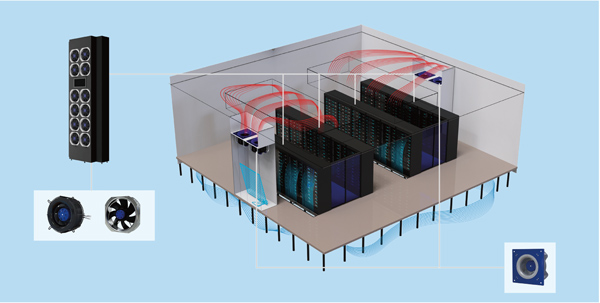
    A modular fan array, often referred to as a FanGrid or fan wall, uses multiple EC centrifugal fans operating in parallel. The number of active fans and their operating speeds can be adjusted according to real-time demand.

    When one fan requires maintenance, the remaining units can continue to provide essential airflow, depending on the redundancy designed into the system. This modular architecture can improve serviceability and reduce the risk associated with a single large fan.

    It also makes future expansion easier. Fan capacity can be planned or upgraded in stages as IT loads and cooling requirements evolve.、
    111.jpg

    Modular FanGrid Solutions Improve System Reliability and Maintainability

    Data Center Fan Selection Is About More Than Airflow

    In data center applications, fan selection should never be based on maximum airflow alone.Engineers must also consider available static pressure, efficiency at partial load, control and communication capabilities, motor protection, acoustic performance and access for maintenance. The selected fan should also operate reliably across the expected system curve rather than at a single nominal duty point.

    These factors collectively determine how the cooling system performs over its full service life. For mission-critical infrastructure operating continuously, the value of a fan lies not only in peak performance, but also in long-term stability, controllability and maintainability.

    Fan manufacturers such as Blauberg Motoren are continuing to develop EC fan technologies with higher efficiency, greater integration and more advanced control capabilities. For data center cooling, air-handling units and precision climate-control equipment, Blauberg Motoren offers EC centrifugal fans across a range of sizes and performance levels.

    Available options can include communication control, enhanced ingress protection and integrated operating safeguards, giving equipment manufacturers greater flexibility when designing and integrating cooling systems.

    Redefining the Role of Air Cooling

    The evolution of data center cooling is not a simple transition from air cooling to liquid cooling. It is a move toward more efficient combinations of technologies, selected according to heat density, equipment design and operating conditions.

    Liquid cooling is well suited to removing heat from high-power processors and accelerators. Air cooling continues to support other electronic components, room-level environmental control and overall system balance. The two technologies are complementary rather than mutually exclusive.

    For EC centrifugal fans, future value will extend beyond moving air. These fans will increasingly connect cooling performance with energy management, intelligent control, redundancy and system reliability.

    Air cooling will not disappear in the liquid-cooling era. Instead, it will become more targeted, more responsive and more closely integrated into the overall data center thermal-management strategy.

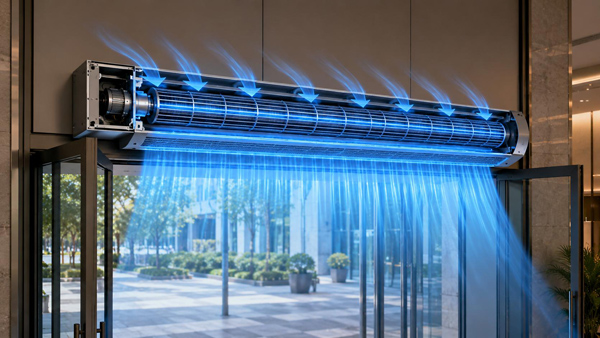
  • Cross Flow Fans for Air Curtains: Even Airflow for Reduced Air Exchange Open Entrances Still Need a Stable Air Boundary

    Entrances in shopping centres, hotels, office buildings, hospitals, restaurants and some industrial facilities often remain open for extended periods or operate with frequent door cycles. While this makes the movement of people and goods more convenient, it also allows air to move continuously between indoor and outdoor spaces under the combined effects of temperature differences, pressure imbalances and wind.

    During summer, conditioned indoor air can escape through the opening. In winter, indoor heat may be lost in the same way. Outdoor dust, odours and insects may also enter with the moving air.

    At times of heavy foot traffic, temperature fluctuations and draughts around the entrance can become more noticeable. This may affect the comfort of people passing through and make conditions around the entrance more difficult to manage.

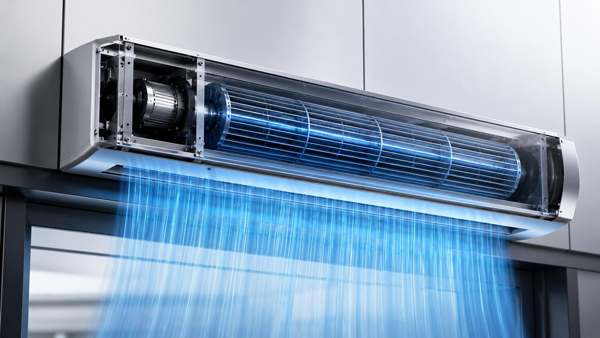
    An air curtain is typically installed above the doorway and delivers a continuous jet of air vertically or at a slight angle across the opening, creating an aerodynamic barrier. It cannot separate indoor and outdoor spaces in the same way as a closed physical door. However, when correctly designed, selected and installed, it can help reduce the exchange of warm and cold air and support indoor climate control around the entrance.

    Actual performance depends on whether the airflow covers the width and height of the doorway, as well as on discharge velocity, airflow direction, indoor-to-outdoor pressure differences and surrounding wind conditions.

    Cross Flow Fans.jpg

    Air Curtain Application at a Commercial Building Entrance

    Air Curtain Performance Is About More Than “How Strong the Air Feels”

    The performance of an air curtain should not be judged solely by its rated airflow or by how strong the air feels directly beneath the unit. More important considerations include whether the airflow remains continuous across the full outlet, whether the velocity distribution is reasonably uniform and whether the discharge jet can reach the lower part of the doorway.

    If airflow is concentrated in the centre of the unit while the ends remain weak, air may still pass through the sides of the opening. Simply increasing fan speed is not always the right solution. It may increase draught discomfort and operating noise, while airflow striking the floor, door frame or nearby walls may produce recirculation and turbulence that disrupt the continuity of the air barrier.

    For an air curtain, a reasonably uniform band of air distributed across the doorway is often more useful than a powerful jet concentrated in one area. The fan must provide airflow appropriate for the doorway, but the outlet grille, guide vanes, internal air path and installation angle also have a direct influence on overall performance.

    Why Cross Flow Fans Are Well Suited to Wide Air Outlets

    Cross flow fans, also known as tangential fans, generally use a long cylindrical impeller with blades arranged along the axis of rotation. Air enters through one side of the impeller, flows across its interior and passes through the blade region a second time before being discharged from the opposite side. This produces a broad airflow pattern along the length of the impeller.

    The design is well suited to the long, slim housings commonly used for air curtains. A cross flow impeller can be installed within a relatively shallow unit while delivering airflow across a wide section of the doorway. Cross flow fans are also used in air-conditioning units, heating appliances and other equipment where installation depth is limited and broad airflow distribution is required.

    However, cross flow fans are not the default choice for every air curtain. Their compact dimensions and wide discharge pattern can be a good fit for commercial entrances with moderate installation heights and limited crosswinds.

    For taller doorways, locations with larger indoor-to-outdoor pressure differences or units with higher internal resistance, the fan arrangement should be assessed against the required airflow, pressure, discharge velocity and throw distance. In some cases, centrifugal fans or other configurations may be more suitable.

    Cross Flow Fan.jpg

     Airflow Organization of a Cross Flow Fan in an Air Curtain

    The Complete Air Path Matters, Not Just the Fan

    The fan is one of the components that generates the air curtain. Before the air leaves the unit, it may pass through the inlet, internal guide structures, heating components, outlet grille and adjustable vanes. Excessive resistance or poorly designed transitions at any point can affect both the delivered airflow and its distribution.

    A cross flow fan should not simply be installed inside a housing without considering the surrounding geometry. The impeller length should match the effective outlet width, while the clearances between the impeller, cutoff and housing need to be carefully designed. The inlet area should also remain unobstructed by decorative panels, suspended ceilings or mounting structures.

    If part of the inlet is restricted, the fan may still meet its catalogue specifications in isolation, yet the complete unit may produce uneven airflow at the ends, higher operating noise or a working point that differs from the intended design.

    For heated air curtains equipped with electric heating elements or hot-water coils, airflow distribution through the heating section must also be considered. Insufficient or uneven airflow may affect component cooling and create variations in discharge-air temperature.

    The fan, heating section, housing and internal air path should therefore be developed as an integrated system during product design.

    tangential fans.jpg

     Internal Structure and Airflow Performance of an Air Curtain

    Installation Conditions Determine Whether the Airflow Reaches the Lower Doorway

    The effective discharge width of an air curtain should normally cover the full width of the doorway. Wider openings may require several units installed side by side, but attention should be paid to the areas where adjacent airflow streams meet, as gaps may reduce the continuity of the air barrier.

    The position of the unit relative to the doorway also matters. If it is installed too far away from the opening, the jet may begin to spread before reaching the area where separation is required.

    As doorway height increases, the airflow must remain coherent over a greater distance. This generally places higher demands on discharge velocity, direction and jet stability. Building orientation, indoor and outdoor temperature differences, door-opening frequency, crosswinds and negative pressure created by extract systems may also influence performance.

    An air curtain can help manage air exchange through an open entrance, but it cannot correct every airflow or pressure problem within a building.

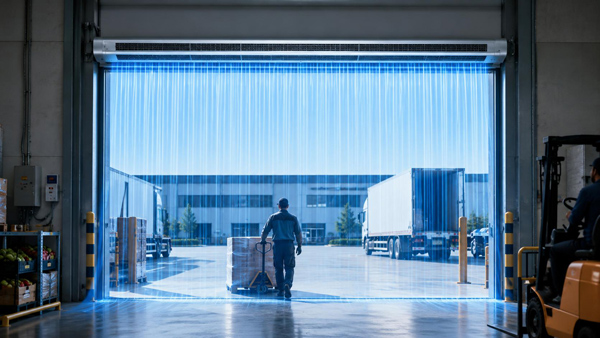
    Cold stores, food-processing facilities and industrial passages may involve more demanding operating conditions, including condensation, dust, corrosive atmospheres and extended running hours. Fan and air curtain selection should therefore be based on actual site conditions, protection requirements and expected operating cycles rather than on a standard commercial configuration.


    tangential fan.jpg

    Air Curtain Application at an Industrial Passage and Loading Bay


    Moving from Fixed Airflow to Demand-Based Control

    An air curtain does not necessarily need to operate at the same speed at all times. Multi-speed or continuously variable control allows airflow to be adjusted according to operating hours, door position and changing environmental conditions, helping to avoid unnecessary high-speed operation.

    Where the selected fan or motor supports PWM, 0–10 V or other control signals, it may be integrated with door switches, temperature controllers or equipment control systems. When the door is closed or traffic is light, the unit may reduce speed or stop according to the programmed control strategy. When the entrance opens, it can return to the required operating condition.

    Variable-speed capability, however, does not automatically guarantee an effective air curtain. Airflow, operating sound and throw distance at different speeds should still be verified through prototype testing.

    During product development, engineers should assess not only the catalogue performance of the fan but also its behaviour after installation in the complete unit. Airflow, sound levels, temperature rise and operating stability should be validated at the actual system working point.

    Matching the Fan to the Requirements of the Entrance

    For air curtains, air coolers and other equipment requiring wide airflow distribution, Blauberg can provide cross flow fan selection support based on housing design and operating conditions.

    The selection process should take into account the effective outlet width, target airflow, system resistance, sound requirements, control method and installation environment, rather than relying only on rated power or maximum speed.

    A continuous air curtain is created by several elements working together, from impeller geometry and motor drive to housing design and airflow control. The value of a cross flow fan lies in its ability to distribute air across a wide outlet within a slim, compact structure.

    It cannot replace a physical door or eliminate all air exchange between indoor and outdoor spaces. In suitable applications, however, it can help establish a relatively continuous and stable aerodynamic boundary across an open entrance.

  • EC Centrifugal Fans in Air Handling Units (AHUs): Applications and Retrofit Practices

    EC Centrifugal Fans in Air Handling Units (AHUs): Applications and Retrofit Practices

    CentrifugalFan.jpg

    The fan is a key element in stable AHU operation

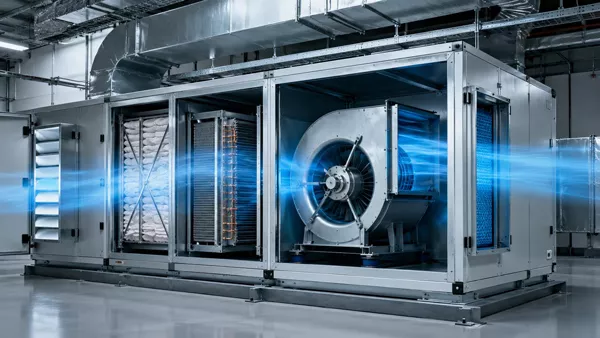
    In a central HVAC system, the air handling unit may not always be the most visible piece of equipment, but it performs several essential functions, including air supply, filtration, heat exchange, humidification and dehumidification.

    After outdoor air enters the unit, it passes through filters, coils, the fan section and the discharge section before being delivered into the ductwork. Throughout this process, the fan keeps the air moving. It also has a direct impact on airflow, static pressure, noise and operating energy consumption.

    For an AHU, the fan is not just an accessory. If it is oversized, it may lead to unnecessary energy use and noise. If it is undersized, airflow may be insufficient, terminal air supply may become unstable, and indoor comfort can be affected. This is why fan selection should be considered at system level, both in new AHU design and in retrofit projects.

    From conventional drive systems to EC direct drive

    Many existing AHUs still use traditional AC fans or belt-driven fan systems. These solutions have been widely used for many years and are technically mature. However, as equipment ages, maintenance requirements tend to increase.

    Belts, bearings and transmission components need regular inspection. Belt tension and wear can also affect operating stability. At the same time, building cooling and ventilation loads are rarely constant. Weekdays and weekends, daytime and nighttime, occupied and low-occupancy periods all require different airflow levels.

    If a fan runs at a fixed speed for long periods and airflow is adjusted mainly through dampers, this can lead to unnecessary energy consumption. EC centrifugal fans offer a practical path toward direct drive, variable-speed operation and integrated control in AHU applications.

    EC centrifugal fans help air supply match actual demand

    An EC centrifugal fan combines an electronically commutated motor, electronic control and a centrifugal impeller. It is typically designed as a direct-drive solution, reducing the need for intermediate transmission components.

    Compared with systems that rely mainly on simple start-stop control, EC fans can adjust speed according to operating conditions. In an AHU system, they can also work with a building management system and respond to pressure differential, temperature, humidity, CO₂ concentration or time-based control strategies.

    This allows the AHU to organize air supply according to actual demand rather than operating under a single fixed condition. For hotels, office buildings, commercial facilities, hospitals, laboratories and clean production environments, this type of control supports more refined system management.

    New AHU design: Start with Operating Conditions, Not Just Fan Data

    In new AHU design, fan selection should not be based on airflow alone. A more reliable approach is to first define the design airflow, external static pressure, filter pressure drop, coil resistance, cabinet dimensions, service access, noise requirements and control strategy. Only then should the fan type and quantity be determined.

    Backward-curved centrifugal fans are suitable for AHU structures that require a certain level of static pressure, especially systems with multiple filtration and coil sections. EC plug fans are well suited for cabinet integration, with a relatively direct airflow path and flexible modular arrangement according to the unit size.

    During selection, the actual operating point should be positioned within a suitable performance range of the fan, while allowing reasonable margin for future changes in system resistance.

    AHU retrofit: not a simple replacement, but a system rematch

    A common misunderstanding in AHU retrofit projects is to replace the old fan directly with a new one based only on the original model or size. In reality, after years of operation, filter resistance, coil cleanliness, duct conditions, terminal dampers and control logic may all have changed.

    Without recalculating the actual operating conditions, a new fan may not deliver the expected result. Before retrofit work begins, the existing system should be reviewed carefully. Key factors include AHU dimensions, fan section space, service door size, foundation and vibration isolation, power supply, control interface, actual airflow, system resistance and noise conditions.

    For AHUs with long operating hours, frequent maintenance requirements or increasing pressure to optimize energy management, fan section retrofit can become an important part of broader system improvement.

    EC-Centrifugal-Fans.jpg

    (Caption: Comparison of the operating conditions between a traditional fan system and an upgraded high-efficiency fan solution.)

    Multi-fan arrangements create more options for large AHUs

    In large air handling units, a single large fan is not the only possible solution. Multiple EC plug fans can be arranged as a fan wall or a FanGrid-style configuration. This approach offers greater layout flexibility and can help improve airflow distribution across filters and coils.

    In applications such as shopping malls, hospitals, data centers and cleanrooms, where continuous operation is important, a multi-fan arrangement can also support more flexible maintenance planning. If one fan requires service, the system can be adjusted according to the project design and control strategy to reduce the impact on overall operation.

    The final solution should always be calculated based on airflow, static pressure, cabinet size and control logic.

    EC-plug-fans.jpg

    Control and maintenance determine whether the retrofit works in practice

    The value of EC centrifugal fans is not limited to the fan itself. It also depends on how the fan is integrated into the control and maintenance strategy of the AHU.

    Through 0–10 V, PWM, Modbus or other control interfaces, EC fans can be connected to a control system for speed adjustment, operating status monitoring and fault feedback.

    In real projects, designers should confirm the control interface, signal type, sensor position, operating logic and alarm strategy in advance. If the system uses constant airflow, constant pressure or demand-controlled ventilation, on-site commissioning is also required to verify performance under different operating conditions.

    Only when the fan, sensors, control cabinet and building management system work together can the retrofit result remain stable in daily operation.

    Blauberg solutions: placing fan selection in a system context

    In new AHU projects and retrofit applications, a fan supplier needs to provide more than product parameters. It must also understand the AHU structure, system resistance and control requirements.

    With EC centrifugal fans, EC plug fans and related motor solutions, Blauberg can support fan selection discussions based on project airflow, static pressure, installation space and control method, offering practical matching ideas for OEM equipment manufacturers and engineering projects.

    For OEMs, the fan solution affects cabinet design, noise control, wiring and maintenance. For retrofit projects, the fan must be compatible with the existing cabinet, ductwork and control system. Looking at the fan as part of the complete system is often more meaningful than comparing product data in isolation.

    Optimizing the air handling system starts with the fan

    The purpose of an AHU upgrade is not simply to replace an old fan. It is to make the air handling system better aligned with the current operating needs of the building.

    EC centrifugal fans provide several technical paths for AHU applications, including direct drive, variable-speed operation, integrated control and multi-fan arrangements. These options give both new-build and retrofit projects greater design flexibility.

    Whether the project is a commercial building, public facility, industrial plant or clean production environment, the AHU is expected to operate reliably over the long term. The earlier fan selection is considered in the system design process, the clearer the boundaries become for commissioning, operation and maintenance.

    For equipment manufacturers and engineering teams, choosing a suitable EC centrifugal fan solution is, in essence, a way to build a more stable foundation for the entire air handling system.

  • Axial Fans for Air-to-Water Heat Pumps: Efficiency, Noise and Reliability

    AxialFan.jpg

    In Heat Pump Operation, the Fan Is a Key Gateway to Heat Exchange Efficiency

    Driven by the demand for clean heating, building energy efficiency and low-carbon renovation, air-source heat pumps are widely used in residences, apartments, hotels, schools, office buildings, hospitals and commercial buildings. They provide heating, domestic hot water and, in some systems, cooling support. For end users, the performance of a heat pump is not judged only by heating capacity. Energy consumption, nighttime noise and stable operation in low-temperature conditions are equally important.

    In the outdoor unit of an air-to-water heat pump, the axial fan organizes outdoor airflow through the evaporator, allowing the air to fully interact with the heat exchanger. Whether the airflow is sufficient and evenly distributed can affect evaporator heat exchange efficiency, defrosting cycles and the overall operating condition of the unit. If the fan is undersized, the heat exchanger may not fully utilize the available heat in the outdoor air, which can increase the compressor load. If the fan is selected too large without proper system matching, it may lead to higher power consumption, increased noise and structural vibration.

    Therefore, the heat pump fan is not just a supporting component. It is a key part of the heat exchange system that requires careful matching. It connects overall system efficiency, operating sound level and long-term user experience.

    Why Axial Fans Are Suitable for Heat Pump Outdoor Units

    Air-source heat pumps need to continuously extract heat from outdoor air. This means the outdoor unit usually requires a relatively high air volume. At the same time, the system resistance of the evaporator is typically within a low to medium range, making axial fans a suitable choice for airflow management.

    An axial fan moves air along the axis of the motor. The airflow path is direct, and the overall structure is relatively compact. This makes it easier to integrate the fan with finned heat exchangers, inlet rings, protective grilles and the outdoor unit housing. For heat pump units installed in gardens, on rooftops, on equipment platforms or beside building façades, this structure helps create a stable air inlet and outlet path within a limited installation space.

    However, the role of an axial fan in a heat pump is not limited to “providing airflow”. Once installed in the unit, the fan must also support stable air volume, acceptable noise levels, speed control and outdoor operating conditions. In residential and commercial applications, fan performance often influences how users perceive the quality of the entire heat pump system.

    Efficiency: From Fixed Speed to Demand-Based Operation

    When the fan becomes part of the heat exchange system, efficiency cannot be evaluated only at a single rated operating point. Air-to-water heat pumps operate under changing conditions throughout the year. The required airflow may vary between day and night, early winter and severe cold, heating operation and defrosting conditions.

    If a fan runs continuously at a fixed speed, it may cause unnecessary energy consumption and make it harder for the system to maintain appropriate performance under partial-load conditions.

    The value of EC axial fans lies in their ability to adjust speed according to heat pump load. Through 0–10V, PWM or communication-based control, fan speed can be adapted to the operating status of the unit. At low load or during night-time operation, the fan can run at a lower speed to help manage energy use and noise. When the load increases or frosting causes higher resistance, the fan can maintain the required airflow to support evaporator performance.

    Of course, fan efficiency is not determined by the motor alone. Impeller diameter, blade angle, tip clearance, inlet ring geometry and the available inlet and outlet space all affect the real performance of the fan once it is installed in the heat pump unit. A good laboratory curve does not necessarily mean the same result after integration into the final housing. A mature fan solution should consider the motor, impeller, airflow guidance and the system boundary of the outdoor unit together.

    ECfan.jpg

    Noise: Details Matter More at Night

    Efficiency affects operating cost, while noise directly affects user experience. Air-to-water heat pumps are often installed close to bedrooms, neighbouring windows or shared outdoor areas. During the day, fan noise may be less noticeable due to background sound. At night, however, airflow noise, low-frequency vibration or speed fluctuations can become much easier to perceive.

    Noise reduction for heat pump fans should not be judged by a single decibel value alone. Tonality, sharpness, periodic fluctuations and overall sound quality also matter. Blade profile, leading-edge design, impeller balancing, inlet ring matching and motor control strategy can all influence the final acoustic impression.

    A well-designed aerodynamic structure helps reduce flow separation and vortex-related noise, resulting in a smoother sound profile. Smooth EC motor speed control can also support reduced fan speed in night mode, helping to limit disturbance to the surrounding environment. For heat pumps used in residential, hotel and commercial projects, low-noise operation has become an important part of product experience rather than a secondary feature.

    Reliability: Winter Operation Shapes Long-Term Reputation

    While efficiency and noise affect daily experience, reliability determines whether the equipment can operate stably over time. Heat pump outdoor units are exposed to rain, moisture, dust, temperature fluctuations and frequent start-stop cycles. In winter, frost may form on the evaporator surface, narrowing the air passage and changing system resistance.

    Under such conditions, the fan needs a certain pressure reserve to handle resistance changes caused by frost, dust build-up or changes in inlet and outlet conditions. After defrosting, condensate drainage, base pan icing or ice accumulation on the grille may also affect the next start-up.

    For this reason, fan reliability should not be assessed only by rated data. Bearing life, insulation class, protection performance, material weather resistance, low-temperature start capability and long-term dynamic balance all deserve attention. As R290 and other low-GWP refrigerants are adopted in some heat pump products, the motor structure, control electronics and installation position of the fan also need to be considered as part of the overall safety design.

    AxialFan.jpg

    Selection: From Component Purchasing to System Matching

    When selecting axial fans for heat pump applications, manufacturers should focus on several practical questions: Is the static pressure sufficient at the target air volume? Can noise be controlled after installation? Is there enough margin under frosting conditions? Can the speed control method be integrated with the main control board? Are motor temperature rise and bearing life suitable for long-term operation? Are the housing, grille and airflow guidance structure convenient for unit assembly?

    These questions are closer to real applications than simply comparing air volume, power and price. The heat pump industry is moving from parameter-based competition toward system-level performance. Whether a fan supplier understands the actual operating conditions of the unit can influence the final product performance.

    Blauberg Motoren.jpg

    Blauberg Motoren has long focused on motors and fans, with product directions covering EC, AC and DC motors, as well as axial and centrifugal fan solutions. For heating, refrigeration, air conditioning and ventilation applications, Blauberg can provide fan-matching references from the perspectives of motor efficiency, impeller design, control method and application boundary.

    For air-to-water heat pump manufacturers, selecting the right axial fan can help improve overall efficiency performance, manage operating noise and support stable operation in low-temperature environments. A heat pump with a good user experience is rarely the result of one core component alone. It comes from the careful matching of multiple key components. The axial fan is one of the parts that deserves close evaluation.

  • Kitchen Dual Inlet Blowers

    Kitchen fume emissions are becoming a major concern in the rapidly expanding catering sector. The global market for kitchen ventilation systems is expected to expand at a compound annual growth rate (CAGR) of 6.4%, from $4.51 billion in 2025 to $7.79 billion in 2034. In the meanwhile, the recently updated “Emission Standard for Catering Industry Fume” has raised the bar for noise control, purification rate, and exhaust efficiency. Blauberg has introduced Dual Inlet Blower fan that offers an integrated high-performance centrifugal fan solution for kitchen fume extraction at this crucial point of industry transition by utilizing its fundamental German technological advantages.

    Blauberg’s Industrial Fans business, a top producer of ventilation equipment worldwide, is dedicated to offering a complete range of products, including axial and centrifugal fans, covering a variety of applications such heavy equipment cooling, HVAC, and industrial ventilation systems. The recently introduced Dual Inlet Blower series is the result of the group’s years of technological accumulation in the ventilation area, and it has over 700 international patents.

    The Dual-Inlet Fan is the Best Choice for Kitchen Fume Exhaust

    Dual-inlet blower fan is a centrifugal fan that has air intakes on both sides of the impeller. Air simultaneously enters the impeller from both sides, concentrates, is driven by the volute, and then leaves through the outlet. It has a complete advantage over single-inlet volute fans in managing kitchen odors because of its structural construction.

    The dual-side air intake’s greater airflow impact is, in theory, completely used by the dual-inlet volute fan. It simultaneously achieves a triple balance of high air pressure, big air volume, and low noise through enhanced volute flow channels and impeller aerodynamic design. The Blauberg Dual Inlet Blower fan is particularly suitable for complicated kitchen situations where it is necessary to overcome many resistances from fire dampers, elbow ducts, and fume hoods. Compared to conventional single-inlet fans, it has a more uniform airflow distribution, reduced vibration, and a 40% increase in airflow at the same rotating speed.

    Why Select dual inlet fans: Four Principal Benefits

    1. Greater Airflow, More Complete Elimination of Smoke

    Everyone’s health and the working environment are directly impacted by how quickly kitchen gasses are expelled. Our dual-intake volute fan efficiently draws in vapors from two inlets at once by allowing air to enter from both sides. The volume and area of the air intake are increased as a result. It produces a greater exhaust volume, extracts fumes more quickly, and eliminates them more successfully than a single-intake centrifugal fan with the same impeller size and rotation speed.

    2. Increased Energy Efficiency Driven by EC Motor Technology

    Energy expenses are a major problem since commercial kitchen fans sometimes need to run continuously for long periods of time. An EC (Electrically Commutated) brushless DC motor is an option for the Blauberg double inlet blower fan. EC motors can reduce power consumption by up to 70% when compared to conventional AC fans. By using electronic commutation technology to eliminate brush friction losses, Blauberg’s in-house EC motor maintains over 85% efficiency even under partial load situations, improving efficiency by 25% to 30% over conventional induction motors. In the meanwhile, the EC motor offers 0-10VDC/PWM dual-mode stepless speed regulation, which enables “ventilation on demand” and prevents energy loss from fixed-speed operation by adjusting the air volume in real time based on the actual oil fume concentration in the kitchen.

    3. A Better Kitchen Environment with Less Noise

    Due to their enormous volume, traditional kitchen fans frequently generate issues for their operators, particularly in restaurants housed in residential buildings where noise complaints are frequent. The structural design of dual-intake volute fans naturally reduces noise since intake from both sides guarantees a more uniform and stable airflow distribution, which lowers turbulence and impact losses during intake and exhaust. When combined with Blauberg’s triple noise reduction technology (noise-reducing holes, sound-insulating materials, and optimized volute design), the Blauberg double inlet blower fans’ operating noise can be controlled between 53 and 57 dB(A), which is significantly lower than the industry average and makes working in the kitchen more comfortable.

    Which type of volute fan is better for  kitchens, a single-inlet or a double-inlet?

    To help customers make more informed decisions, we provide a comprehensive comparison of single-inlet and double inlet blower fans from several perspectives. In addition to  kitchens, our clients may select the best fan for their sector.

    Airflow: Due to its single intake, single inlet blowers provide modest airflow. Double inlet blowers are better suited for medium-sized to large-sized  kitchens with larger exhaust volume needs since they feature two inlets that increase airflow by around 40% at the same rotating speed.

    Pressure: For high-rise smoke extraction or long-distance ducting, single inlet blower fans provide higher pressure. Because of their superior volute flow channel design,double inlet blower fans also perform very well in terms of pressure, sustaining stable operation at medium to high static pressure circumstances (845Pa).

    Noise Level: By using cutting-edge aerodynamic design and noise reduction technologies, our double inlet centrifugal blower fan has greatly reduced its noise level, consistently enhancing its overall noise management capabilities.

    Maintenance and Cleaning: double inlet centrifugal blowers usually have a bottom drain outlet (oil valve) that permits condensed waste oil to naturally flow along the curved casing to the bottom for discharge, reducing buildup. The impeller design also makes cleaning and disassembly easier.

    Blauberg’s IoT-Enabled Solutions for the Smart Kitchen Era

    Intelligent technology is becoming a necessary trend for effective kitchen ventilation as the industry speeds up its transition to “fully automated, low-emission, and highly integrated” systems. Blauberg’s double inlet centrifugal fan seamlessly interacts with Industry 4.0 platforms and smart home systems thanks to an integrated IoT-ready controller that supports the RS485 communication standard. In order to provide intelligent smoke control, energy management, and predictive maintenance, the fan may modify operating settings in real time depending on sensor data. This lowers operational expenses for catering companies while satisfying ever-tougher environmental regulations.

    Intelligent ventilation solutions are quickly becoming more and more popular in the global market for kitchen ventilation systems. Innovative technologies like demand-controlled variable speed fans, IoT-enabled real-time air quality monitoring systems, and heat recovery devices are being adopted at an increasing rate. A standard device that fits this technical trend is Blauberg’s dual-inlet volute fan.

    Blauberg double inlet double with centrifugal fans are utilized in key areas of  kitchens, such as star-rated hotel kitchens, central kitchens, chain fast food restaurants, school canteens, large supermarket food courts, and hospital catering centers. They have a broad range of applications and promising global market prospects. Customers both domestically and abroad have acknowledged the product performance and technical dependability of this series of centrifugal fans, which are also widely used in air conditioning systems, purification equipment, industrial ventilation, refrigeration equipment, and fresh air units.

    According to market research, as the global QSR (fast food) business grows and indoor air quality regulations tighten, the  kitchen ventilation system market will continue to rise quickly. Using a four-in-one technological innovation approach—high efficiency, energy saving, quiet operation, and intelligent technology—Blauberg will continue to capitalize on its German technological heritage and localized manufacturing advantages to offer top-notch centrifugal fan products and ventilation solutions to customers worldwide.

    Please visit the official Blauberg product page or get in touch with our knowledgeable staff via our website for specialized kitchen ventilation solutions to find out more about Blauberg’s double inlet centrifugal blower fan and complete line of centrifugal fans.

    centrifugal fan .jpg